

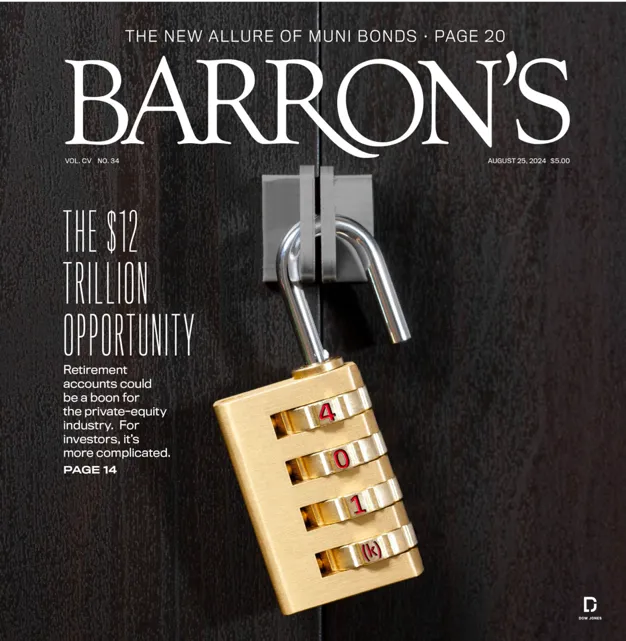
What are alternative investments?
Alternative investments come in three flavors:
1) Venture capital firms use their clients’ funds to seed start-up companies with the hopes that a few investments’ dramatic successes significantly outweigh the losing and mediocre investments.
2) Hedge funds are leveraged partnerships that can invest in just about anything on behalf of their clients, and
3) Private equity firms, which invest clients’ funds to buy existing companies with the intention of eventually exiting the investment by selling to another buyer or listing the company on a stock exchange.
Private equity sounds cool and exclusive. It has the appearance of a velvet rope and bragging rights. Think of the ego boost of investing in private equity as similar to providing an investor with the ability to boast that they are an “owner” of a West Portal restaurant. Did you get an equity interest, or is your investment a loan? Did you read the prospectus? Do you even care?
The Giants versus the Atlanta Braves: a comparison of two MLB franchises
The three categories of alternative investments share a similar lack of transparent valuations and expensive fee schedules. To illustrate the differences between an investment delivered as an alternative investment versus a typical investment on a stock exchange, I am going to contrast two Major League Baseball franchises.

Chicago, home of the 1919 Black Sox game-fixing scandal, now has sports book on the same block as Wrigley Field
In early 2025, the Giants allowed the private equity firm, Sixth Street, to purchase 10% of the franchise for $380 million. However, if you would like to invest in the Giants, you’d better have a hookup with Sixth Street. You can’t just walk in off the street and invest. Contrastingly, any adult with an online brokerage account can invest in the Atlanta Braves by purchasing their shares on the Nasdaq.[i] Query: which is more democratic: needing a connection to get in the door, or merely turning on your computer to invest?
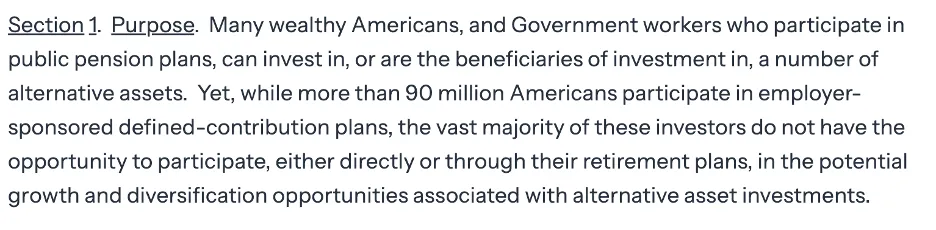
Ironically, on August 7, 2025, President Donald Trump signed an executive order Democratizing Access to Alternative Investments for 401k Investors.
The velvet rope will still always exclude us average investors
I can assure you that the “democratized” investments described by Wall Street and the President are the investments the affluent have already analyzed, picked through, and passed on. “You want to invest in the Giants or Warriors? Sorry, that’s going to a tech CEO who promised my brother they would go public through his firm. Hey, but we have a sexy coin-operated laundry franchise you might be interested in?”
Now, if that’s how difficult it is for the unconnected to participate in a private equity deal, how unique will the alternative funds be that are destined to be buried in your 401k or deferred comp? But these generic alternative investments will be marketed to unwary 401k and deferred comp investors as if they have been admitted to an exclusive club.
The two-and-twenty fees takes too big of a bite out of investment returns
I am using the Giants and Braves as an example because it’s easy for readers to visualize the two similar sports franchises. To be clear, I am not privy to the specific contract arrangement Sixth Street has with their investors. Only for purposes of illustrating the general alternative investment arena, I am applying the standard alternative investment industry fees, known as two-and-twenty, to my Sixth Street-Giants example.
What are two-and-twenty fees?
First, the 20% layer of fees:
The first layer of fees Sixth Street retains is 20% of the profits on their portion of Giants’ earnings. There are two components to the 20% of profits:
a) The Giants earn operating profits from ticket sales, food and merchandise, and contracts with broadcasting. Let’s assume the Giants generated $24 million in net income, of which 10% belongs to Sixth Street’s investors, of which the Sixth Street’s firm will keep 20% of their investors’ profits. That equals $480,000.[ii]
b) However, most people invest in sports franchises for the appreciation. Sixth Street also will charge investors 20% on the amount the Giants’ franchise appreciated in 2025. Forbes magazine has only been able to guestimate the Giants’ current value at approximately $4 billion. It’s concerning that if Forbes can’t nail down a base value for the Giants’ franchise, but then somehow Sixth Street can accurately calculate appreciation on that vague base value, and then take 20% of that appreciation as their fees? Would you want your real estate broker to collect fees on their calculation of your home’s annual appreciation?
Let’s assume the Giants’ franchise appreciated 8% in 2025. The Sixth Street managers will collect $6.1 million in fees from their investors. ($380 million share x 8% x 20%). But I’m not even close to totaling the fees Sixth Street is going to siphon from its investors.
Second, the 2% layer of fees:
The second set of fees that Sixth Street will—annually– charge their investors is 2% on their $380 million stake in the Giants’ franchise, or $7.6 million.
While Giants President Buster Posey is doing all the grunt work running the team, Sixth Street will just kick-back and earn a total of $14 million in fees[iii] from the Giants’ $32.8 million in profits and appreciation. Essentially, Sixth Street takes 45% of their investors’ profits because they put the deal together.[iv]. That’s all they did.
With the friction of these imposed fees, do you really want to be investing in a private equity firm’s investments? Or might it be better to actually invest in the private equity company’s stock, like Blackstone, KKR, Carlyle, or Apollo? And wouldn’t you have more investment potential by investing in the highly regulated, transparent, and liquid Atlanta Braves, than in the opaque and illiquid Giants through Sixth Street? [v]
No transparency to Sixth Street’s accounting and valuation
Unlike the Atlanta Braves, a publicly traded company, there are no government regulatory bodies that oversee the Giants’ or Sixth Street’s financial reporting. Or a requirement that the franchise’s financial statements must be audited by a large CPA firm.
Neither the Giants nor Forbes calculates annual appreciation, making the alternative managers’ calculation a huge conflict of interest. The greater the appraisal, the greater the private equity managers’ take-home pay. Topped off by Congress allowing the managers to be taxed at a lower rate than everyone reading this article.[vi]
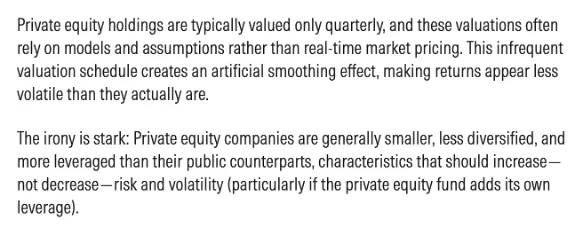
Unlike stocks that are priced every weekday, when the managers of alternative investment calculate their investments appreciation, they also have a huge incentive to make the investments appear less volatile, and seemingly safer. This illusion of stability is a big selling point to public pension plans. As recently described by Morningstar:
Alternative investments are coming to SFERS deferred comp
I have been hypercritical on the investment underperformance of public pension plans because of their allocation to alternative investments (including private equity). By my calculation, those democratic investments cost the San Francisco employees’ public pension plan more than $5 billion last year compared with what the pension could have earned on a brainless index fund. But the city employees’ deferred comp plan with Voya, has nowhere near the protections or government oversight that the SFERS pension has.
By law, the managers of the SFERS $35 billion pension plan have a fiduciary duty to put the interests of city employees before any outside or personal interests. Similarly, managers of 401k plans or investment advisors (like me) managing your account also have a fiduciary responsibility to participants. However, because the deferred comp plan is not protected by ERISA law, the Retirement Board and the employees of SFERS have historically given greater priority to the less conventional investments[vii] because of political donations made by the alternative investment firms to political candidates. Watch out, SFERS doesn’t have your back.
As reported in the Wall Street Journal, the investment firm, Blue Owl Capital, is working with Voya, SFERS’ deferred comp provider, to bring private (alternative investments) market to 401(k) and defined contribution plans (deferred comp.) “The partnership will initially focus on creating vehicles that are essentially the building blocks of all-in-one funds known as target-date funds.” That follows Goldman Sachs investing $1 billion in T. Rowe Price, a mutual fund distributor, so that they can get alternative investments into target-date funds. So, even if you don’t invest directly in alternative investments, Voya will probably be hiding these alternative investments in their target date funds.
With the intrusion of alternative investments into thinly monitored deferred comp, your interests are doomed for backseat treatment.
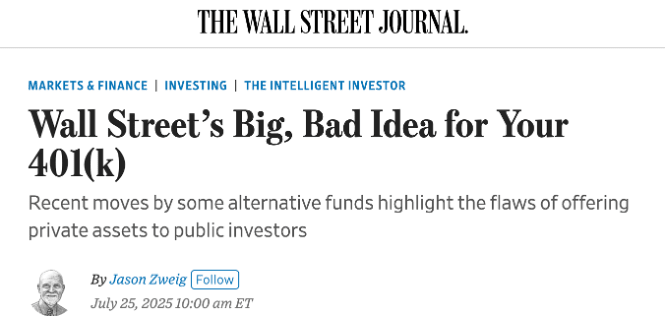
Wall Street Journal’s Jason Zweig says, “just say no.”
If you think my analysis is skewed, here is Jason Zweig of the Wall Street Journal’s take: “Wall Street’s Next Big Idea for your 401k Is a Bad One.”
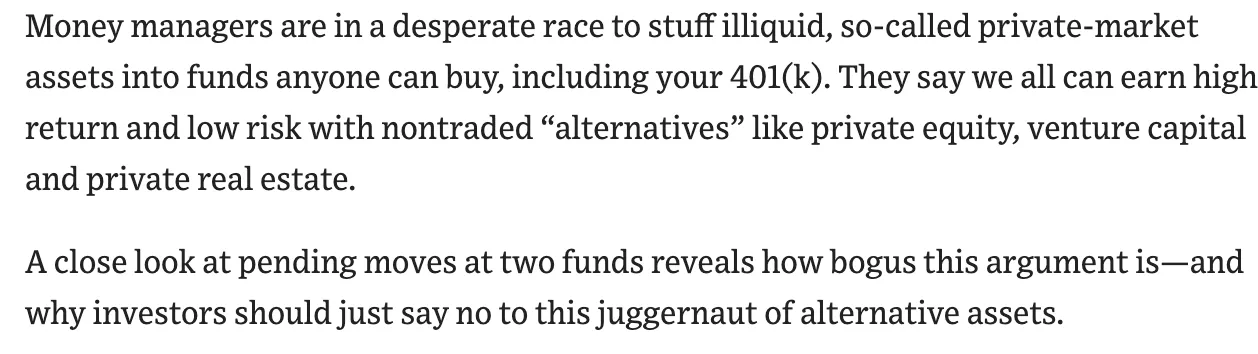
Jeffrey Gundlach’s October 10, 2025 comments on alternatives (subsequent to my article):
[i] The Atlanta Braves, unlike Amazon or Nvidia, is structured as a “holding company” that owns the Atlanta Braves’ shares.
[ii] Per Forbes, in 2024, the year before Sixth Street obtained a 10% interest, the Giants lost $24 million from operations. I made this a positive number for simplification.
[iii] $480,000 from the share of the Giants’ operating profits + $6.1 million on the appreciation of the Giants’ franchise +$7.1 million from 2% of the $380 million investment in the Giants.
[iv] These are the percentages on how much an alternative investment company keeps of an investment’s profits
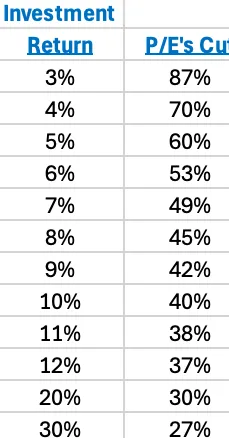
[v] 2026 will be the last year of the contract between players and owners. There is a potential strike storm approaching on the horizon. I am not recommending an investment in the Atlanta Braves.
[vi] Due to the “carried interest” rules, the owners of Sixth Street will not calculate their taxes on the IRS bracket schedule of 24% or 32% like you and me. Sixth Street executives will treat their income as capital gains and be taxed at a maximum of 23.8%. And no social security is paid either.
[vii] Deferred comp is composed of a tax-deferred variable annuity in a tax-deferred account. A person with a fiduciary obligation would have some explainin’ to do on this one.